Archive

Author Archive

A note on Tom Hardy and the film ‘Bronson’

December 24th, 2010 No comments

Back when The Wrestler was released two years ago I read this quote describing Mickey Rourke in the film; “A harmonic convergence of player and part that happens only once in a blue moon.” That’s from David Ansen of NewsWeek. Once in a blue moon?  Ansen must’ve missed Tom Hardy in Bronson, released in the same year.  If Rourke’s performance is a blue moon then Hardy’s is Halley’s Comet.

It’s a one man show! Starring Britain’s most violent prisoner and most expensive mental patient. He stands before a captive audience, breaking the forth-wall as he addresses us directly and announces, “I’ve always wanted to be famous.” But he can’t sing, ball or act so his options are limited. Yes,  he has a violent streak, he’s had it since childhood, so it’s a life of crime for Michael Peterson (who later adopts the moniker Charles Bronson).

When Peterson is first arrested it’s for a relatively small crime; he steals 18 quid from a post office and then is sentenced to 7 years.  The sentencing is comedic, in fact a lot of this film is comedic. It’s a tragicomedy that just happens rank among the most violent films.  In fact, Danish director Nicolas Winding Refn shows tremendous skill in implementing an almost Kubrickian sensibility in both his visual style, his surreal approach to violence and  his ability to extract raw performances from his actors.

But how does a man go from sticking up a post office for 18 quid to being the most violent criminal in Her Majesty’s Prison Service? I think it looks like simple boredom. But he is presented to us as a man who loves prison. He loves his “hotel room,” as he calls it, and he loves to strip down naked smear himself in butter and go bare-knuckle to riot-gear against a slew of prison guards. And Hardy presents this to us with such bravery and uncompromising dedication that you believe every second.

There’s an amazing moment where we cut back to the stage, as is done regularly throughout the film, where Bronson is split like Two-Face. One side is himself. The other side is made up to be a nurse from the mental hospital at which he attempted to kill another patient. He whips back and forth, recreating a conversation – “when’s my trial!?” Bronson screams. “There isn’t going to be a trial.” The Nurse responds. “But I want my hotel room back.” – It’s a marvelous and inventive way to move the story along quickly, mixing again this surreal style with a bitter comedy and inspired theatrical performance.

Bronson ends up being a surprisingly innovative biopic that some critics have dismissed as just being “a pointless exercise in morbidity.” But such an over-simplification of this film is board-line criminal.  Refn’s bold profile of a violent man doesn’t shy away from the brutality of his life, but he does undercut the violence with his brilliant use of music, mixing rock, opera, classical and The Pet Shop Boys.

This is just another instance, in a long list of examples, that proves most awards are jokes.  Sean Penn won the Oscar this year for his role in Milk. It’s a very good performance, but doesn’t belong in the same category as Hardy’s performance. It’s the equivalent of ignoring Charlotte Gainsbourg at the Oscars last year. But to hell with award shows simply recognizing studios trying their damnedest to promote their films to increase their box-office after spending a mint on an awards campaign.  Awards can be a kiss of death to some.  What has Gooding, Jr or Berry or Bullock or Paltrow done since their awards?  Sometimes the award can be a mark of the end, not the beginning. Hardy’s performance here marks the beginning of a very exciting career and it will exist now as one of those fringe performances that wasn’t promoted relentlessly to the public.  It is one you need to discover years later on Netflix on the recommendation of a rambling, lowly, fringe writer….

Categories: Patton Notes, See It, Uncategorized Tags:

Rambling about The Fighter from the comfort of my home…

December 24th, 2010 No comments

Another benefit to being on the fringe,  Academy screeners! They send out DVDs packaged by hundreds of assistants all over Hollywood so voting members (which unfortunately I am not) can decide on the top award while dealing with all the home distractions. So, with the hype swirling and anticipation peaking, I put in The Fighter.  I’ll start by admitting I had no idea who Micky Ward was before this film.  Maybe it’s because I was only 16 when Micky was starting his comeback and, him not being a fully developed female high school sophomore, I didn’t care to know who he was. And maybe because when I watch SportsCenter I listen to baseball, basketball and football (soccer every four years like a good American) and ignore all else. I could name all the boxers I know quite quickly – Ali, Foreman, Dempsey, Leonard, Liston, LaMotta (thanks Scorsese), Tyson, Holyfield, de la Hoya, Douglas and…. and I think I’m out.  Not being a huge fan of boxing didn’t detract from my enjoyment of Raging Bull, Rocky, or Million Dollar Baby, and didn’t for The Fighter either.  But still, other distractions did play a role in this viewing.

It was about dinner time, the wife and I just put Bean down for a nap, the food is on the table and we get ready to see what people are calling the best movie of the year. They are raving about this. I’m sure you’ve heard the hype, it is December after all and with the award season upon us you’re going to see a lot films bragging about their dubious nominations for SAG and Golden Globes (Alice In Wonderland Best Picture? Seriously?).  The Fighter has four SAG Award nomination, six Golden Globe nods (that’s right, people keep giving Melissa Leo nominations, damn it.)

We come into Micky’s life after he’s already made a name for himself as a boxer and is slumping.  He just lost four fights in a row and he’s being considered a “stepping stone,” which in boxing terms means he’s the guy you want your boxer fighting so your guy can move up the ranks.  His brother, Dicky Ecklund, has already seen his glory days; he knocked down Sugar Ray Leonard (the Leonard from my list above).  But now all Dicky has going for him is Micky, an HBO documentary crew, a crack addiction and a Cambodian crack whore that he always seems to be tangled up with when Micky needs him most.  I should digress briefly

real Dick Ecklund / Bale as Ecklund

to just echo what everyone is saying; Bale deserves, actually deserves, an award here. He and David O. Russell both deserve the nods they’re getting, but Bale’s award is going to be for his entire body of work.  He’s a tremendous actor and has been snubbed enough. And, like in this film, he always seems to be at his best when he’s emaciated (see The Machinist and Rescue Dawn).

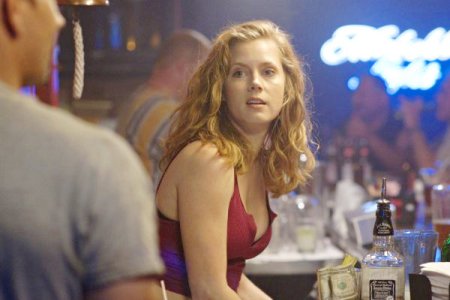
The Mungin fight ends, Ah! I have time to grab more wine, shouldn’t take long, so I get up, go to the kitchen and grab the bottle.  I pour the glass, but before I sit, real quick, to the bathroom and I’m back.  It’s at the this point we find Micky getting an offer to train full time in Vegas.  He needs to sort of “break up” with his mother and brother who are his manager and trainer respectively.  For extra support he brings his new girlfriend Charlene, played by Amy Adams.  I loved Amy Adams in this role. She’s gone from the very innocent girl in Catch Me If You Can and Junebug to this tough talking bartender who can match attitude and grit with the apparent harem of hookers living in Micky’s house.

Needless to say, the “break up” with the family doesn’t pan out and Dicky swears he can get enough money keep Micky in Lowell and train year-round.  But, remember, Dicky is on crack. So his idea to pimp out his Cambodian girlfriend and rob the johns in order to raise money is ill-conceived at best and fails, resulting in a small falling out with the family and Micky contemplating retirement.  This is just about the low-point for the family.  Micky has a broken hand, isn’t fighting or talking to his mother, Dicky is in jail and just found out the documentary they did on him wasn’t about boxing but about his crack addiction. Oh, and it looks like Charlene doesn’t want to be around sad-sack Micky any longer.

PAUSE! The kid woke up.  Okay, rough wake-up, so we calm her down, get her fed and then try to entertain her with toys while we resume the movie.  To avoid spoiling more I’ll sum up.  The Fighter ends up being an uplifting film with tremendous heart.  It teaches us that even at rock bottom you need to remain tenacious and that you need to continue to support your family even if your mom is the easiest, most fertile white trash in Massachusetts and your brother is a crack head.  There is a tremendous value in loving and being loved unconditionally and with that sort of support behind you, you can always pull yourself up.  It’s a good message. And I always like David O. Russell’s work, I don’t think he’s made a movie I didn’t like.  His dedication to accuracy during the fights was brilliant and I applaud he choice to use old Beta to tape the fights. I read that he choreographed each bout by recreating the tapes of Micky’s actually fights and recorded them with the help of directors and cameramen from HBO Sports.  They’re best boxing scenes since Raging Bull and the best aspect of the entire picture.

I didn’t love this movie, though. Could it be the hype? No. Maybe it was because of Melissa Leo. I just don’t care for Leo and she posted negative marks with me when watching this film. Which is fine, some actors just rub audience members the wrong way, I’m sure there are actors you just don’t care for. But, you know how they say when you are in a role with great actors supporting you, you raise your game?  Like when playing with better athletes.  Not here. It’s like putting a 19″ Toshiba TV next to an IMAX screen… your Toshiba doesn’t all the sudden perform better, in fact it’s worse now that you have a comparison.  Leo is the Toshiba. And it made Bale look like an IMAX.

But no, there are movies out there that I love and they have actors I don’t like in the cast.  This isn’t Leo’s fault. I think I didn’t enjoy this movie fully because of home distractions. I never got 100% invested, and that raises the question: how many Academy voters are just watching these movies at home, or at the office or on their laptop on a plane? I think when people vote based on home screenings, tragedies like this can result

Categories: Patton Notes, See It Tags:

A stream of thought on a King’s Speech tease…

December 16th, 2010 No comments

hanging low the fog coming off the ocean miles off it smells like salt a salty rain that smell of rain just moments away chilling a hot decemeber day hot in december 80 + degrees  i miss colorado decembers hot on the sunset gower lot and an endless meeting endless list of games but tonight a walk a walk through a salty low lying fog headlights blooming im relaxing 915 walk to landmark theater anticipating Kings Speech with much hype they always hype everyone hypes i despise overhyping a film nothing ever lives up to the hype but excited to see firth and rush and carter and the house of leder and the worlds worst vegan for free he donates blood at ucla with movie ticket voucher rewards that i cannot get because of a bone graft less than a year before tonight i am walking through salty low lying blooming beautiful late night la fog to a landmark with the worlds worst vegan and the house of leder to see the king give a speech

ALACK! deception the man in a horrible shade of burgandy cries out this theater is screening the taymor adapted shakespeare finale The Tempest SPRING! up my head and wide  my eyes look to W.W.V and the house is laughing but jokes on him the language of elizabeth will spin his head and how does he a man that loves nothing but bourne agree to this he loves the action the quick dialogue landing firmly on the nose wont watch a black and white and now a psychedelic trip navigated by the woman that helmed titus that i never finished nothing spectacular couldnt hold my interest and frida that somehow bewitched me on first viewing and lost it lost it lost it on each subsequent dvd attempt despite naked selma hayek then the public raping of the beatles anthology jumping from decent segment to atrocious so why not      why not turn prospero into prospera why not see caliban as merely a black slave caked in mud and not the deformed monster that i once while in undergrad envisioned when reading the tempest for the first time i saw caliban a foolish naive villain of sorts that wants nothing more than to reclaim a throne he has rightful claim to but will never sit where his mother sat for he’s a slave to prospera still doesnt sound right and played well by the djimon hounsou from the slave rebellion aboard the amistad amazing but was not directed as the villain that i always hoped to see caliban nor were there any true villian AH! the heart of the issue with this film it is a lack of true conflict conflict being the catalyst of drama conflict being the impetus to story so why ignore conflict ms. taymor why oh you must be distracted think you can distract us with onslaught of visual stimulus my phone vibrated i check Ooo email why not not into the story i lean to the leder he leans to me and i what do you think and he i  forgot how much talking is in shakespeare and i that is sort of his thing and he just laughs goes back to not paying attention to why is ariel now a blue genderless spirit how is prospera this omniscient omnipotent being omnipotent only by commanding ariel who can do anything so why not break the bonds of slavery and suddenly Distraction! russell brand comes not so nimbly over the rocks and spastic and drunk and slurring and aldous snow speaking in iambic pentameter is still aldous snow

a visual barrage an intellectual bore and everything goes exactly to prosperas plan and what conflict what interest what drama what its hardly even a story the way its presented shakespeare must be pissed as i think of it days later it gets worse or maybe i just romanticized the tempest when i first read it and would be just as disappointed if i revisited but i cant no i wont believe that i liked the tempest before i can like it again despite taymor despite aldous snow and despite oh wait there was a shining star in the thats a song by the manhattans by the way the shining star here is that felicity jones  where has she been my whole life she a beauty she that handles the shakespearean prose with a masterful tongue nibble lips and possesses the innocent curiosity that i wanted to see in miranda she matches blow for blow with veteran actors no doesnt match outshines those veterans perhaps im too harsh on the movie perhaps it could be enjoyable if i suspend disbelief suspend thought suspend intellect simply enjoy the spectacle enjoy the prose enjoy felicity because how beauteous this film is o brave new tempest that has such felicity in it

Categories: Avoid It, Patton Notes Tags:

A note on the ‘Minute to Win It’ & “Plastic Bag”

December 10th, 2010 No comments

For almost two months I have been working for NBC on the show Minute To Win It. We shot several episodes at the end of last month and the highly anticipated (?) premiere was this past Tuesday.  An hour long ‘life changing’ show where tear-jerking moments waxing sentimental are interrupted by brief sixty-second stints of home-grown challenges.  The goal for the contestants? Complete each sixty-second challenge to win 3 Million dollars (upped from the usual one-million for the special holiday episodes).  And as I was watching a contestant gyrate and jump on the glass stage my eyes drifted down to my laptop where I was loading a short film that I saw earlier this year and decided to revisit.

Werner Herzog voices the internal thoughts of the Plastic Bag in Ramin Bahrani’s short film Plastic Bag. It gives us insight into the philosophical thoughts of a piece of trash, or what we accept as trash until we project human emotion on it, and suddenly we care for an inanimate object.  I haven’t cared for a household object like this since Spike Jonze’s lamp commercial for Ikea.

The bag is given an amazingly complex personality, one that holds all the characteristics of an innocent child that must learn the world on his own.  In innocence we often find love, blind unyielding love like the bag has for his Maker. He is happy to be put to use, to have purpose in her life. The happiest moment is when he is filled with ice (a shocking experience) and then gets to rest on the warm injured ankle of his Maker.

He clearly cannot understand rejection.  Expelled with the rubbish he finds himself fighting monstrous Earth-movers in a landfill.  Thus begins his journey.  He must find Her again.  A comparison to Spielberg’s A.I: Artificial Intelligence can be drawn from the beginning, but now it is too obvious to ignore.  Given the idea that love lives with a being until death, and given that neither the robot nor the bag can die, we get an endless search to recapture that amorous feeling.  I hear Guy Fieri exclaim, “You’ve got a minute to win it, good luck.” I look up.

Two sisters spin wildly with ribbon around their waists on a game titled “Christmas Ball Conveyor.” I think this was for 10,000 dollars.   And the bag finds plastic bag prophets that tell him of a place called the Pacific Vortex, where billions of bags in a mass the size of Texas swirl in the ocean.  He ventures now to find the companionship out in the vast waste forming in the sea.

Plastic Bag raises questions philosophical, environmental and theological.  Do we all sympathize with this plastic bag because we all have that yearning for love, is it that “God Hole” that may exist in everyone? Perhaps we all just hope to find purpose and meaning to our existence and that one desire keeps us moving until we either die or accept that meaning is an artificial construct.

The short film is beautifully shot by Michael Simmonds. Herzog’s narration sounds lyrical, it possesses a true curiosity and vulnerability that is necessary to portray a character of this innocence. It’s the exact opposite of how I imagine the legendary Herzog – the sort of director that would pull a gun on his actor, eat a shoe to satisfy a bet.   The direction by Bahrani accomplishes in 18 minutes what master story teller Spielberg couldn’t accomplish with his 2 and half hour mess, A.I.

It’s the sort of film that inspires other filmmakers, full of an intelligent creativity that can find an emotional story in a common grocery bag.  And one of the sisters balances martini glasses on Christmas ornaments – I think for $250,000 – but the martini glasses start to wobble and… to be continued. Whoa. Cliffhanger.


Categories: Patton Notes Tags:

Rambling about Thanksgiving dinner

November 27th, 2010 No comments

Every other year my in-laws are in town for Thanksgiving and we go to Jim Brown’s house in the Glendale hills for dinner.  He’s the uncle to my brother-in-law. And no, it’s not the Jim Brown you’re thinking of; this Jim Brown didn’t play football and it’s not the casual name for the legendary singer (obviously).  This is “Our Man In Hollywood” Jim Brown, the retired Hollywood reporter for the Today Show.

His home is a nice ranch style home with a million dollar view of Glendale and in the distance, springing magnificently out of endless strip mall sprawl, are the high-rises of LA.  Looking directly west off his back porch is the best sunset in the greater Los Angeles area, see the picture below.But the most interesting thing here isn’t the view and it isn’t the house. It’s the man inside and his brilliant library of Hollywood books and biographies, most of them signed. I stood in awe in his library, looking at a wall of books.  I didn’t know they were signed when I started thumbing through them but when I opened the Hitchcock Truffaut book, the epic book-length conversation between Hitchcock and Truffaut, I was surprised to see a large swooping autograph from Hitchcock complete with a simple sketch of the iconic Hitchcock silhouette. Then, tucked into the lower corner was a small note to Jim scribbled and signed by Truffaut in handwriting that is barely legible.  Amazing. And that wasn’t all.  The other prize gem in the collection was an autobiography of Orson Welles, again signed. But this one came with a story.

Jim was thrilled to interview Orson Welles, who was very open and congenial during the interview.  He agreed to sign the book and wanted to do a quick drawing of himself on the first page. The sketch was rough, but Jim liked it, and continued the interview.  As the interview came to an end Welles asked for the book back. Jim was reluctant to give him the book, he asked why. Welles wasn’t pleased with the drawing and wanted to have time to finish it, promised that he would send the book back to Jim if Jim would leave an address.  Jim left the book and the address assuming he’d never see the book again.  Over a month later the book arrived, with this odd drawing of Welles, done with in pen and then painted with what looked like water-colors – and it’s not the young Welles that we all remember. This the bearded, rotund Welles from F For Fake and the drawing is perfect.

During dinner Jim was tending to all the food.  He was very quiet, didn’t talk to many of the guests and at the table he sat at the head with his wife and didn’t participate in much of the conversation.  He gets around slowly now, looking uninterested in much of what is being said and just concentrated on make sure we all had enough food and wine. When I got up to hit the bathroom I passed again through the library and spotted a book written by an old professor of mine, Paul Seydor.  It was “Peckinpah: The Western Films.” I returned to the table and mentioned to Jim that Seydor was a professor of mine and Jim lit up.  He didn’t much care for Peckinpah, calling him “crazy ol’ Sam,” but this began a film conversation that went on long enough I’m sure it eventually bored everyone else at the table.  Jim went from quietly eating his dinner to telling tales about flying to England to meet with David Lean, having long-winded conversations with Roger Corman and how memorable Sam Fuller’s voice was in person.

Jim is the sober version of Mank. Hearing his stories reminded me of sitting in Tom Mankiewicz’s class. The only difference being that Mank loved the seedy stories of the underbelly of Hollywood while Jim liked the nostalgic, prettier stories of Hollywood. It’s the difference between a film directed by Frank Capra or some Sam Fuller noir picture.

But something else dawned on me during my dinner with Jim; my true knowledge of American films before the 70’s is lacking when compared to Jim’s.  I knew more about the European filmmakers than he did, and that’s when I became a little upset with my film education. Why had I spent so much time learning and watching the films from the French New Wave and from the film school brats of the 70’s and not the films that inspired them? In the Cahiers du Cinema conversation between the notebook’s founders they exalt the American directors for their work as they deride the directors and writers of their own country.

So, for “Our Man In Hollywood” Jim Brown I’m going to dedicate some time to revisit the American filmmakers of the 30’s, 40’s and 50’s. I haven’t seen the Lubitsch musicals or his To Be Or Not To Be with Carole Lombard and Jack Benny – nor have I seen the Golddigger musicals, but I will now.  I’m going to explore the noirs and westerns that Jim told me I cannot go another day without seeing and I’ll let you know how it goes.

Cheers to a wonderful Thanksgiving…

Categories: Patton Notes, Uncategorized Tags:

A Note on Cassavetes, Bier and Crazy Women

November 25th, 2010 No comments

It’s Thanksgiving, lets ramble about the movies I’m watching.

Over the weekend/days off leading up to Thanksgiving I watched the movies from Netflix that have been sitting on my TV for about two weeks.  It felt ironic that I watched them just after watching Black Swan because there was a clear connection between them that I will explain now.

First up, A Woman Under the Influence, written and directed by John Cassavetes. What’s the connection, you might wonder, between a cinema verite style drama and a modern sleek thriller like Black Swan? Simply put, it’s the common theme that women are freakin’ crazy.  Nina was stressed out of her mind over just being the prima ballerina? She was acting like she was the first person to ever have the lead in a large production.  The histrionic response leads every rational person to the conclusion, she was freakin’ crazy! And two days after I saw Nina loose her mind, I watched Gena Rowlands loose hers.

If you’ve seen A Woman Under the Influence you know that from the very beginning Mabel is unstable.  Her descent isn’t a far one, but the level of performance from Rowlands is one of the most impressive in modern film.  She would have made an amazing Lady MacBeth.  The scene when Nick is having the doctor come take Mabel is heart-wrenching, beautiful and so real that it people believed it was completely improvised (which Rowlands denies in the special feature interview, claiming you could never improvise that scene and Cassavetes scripted the entire thing).

Unfortunately for the kids in the film, they are screwed whether or not Mabel goes to the mad-house because their father seems equally unstable.  He looses his temper easily, yelling at friends on a trip to the beach, yelling at them for asking about his wife and going from a man trying to convince she needs help to holding her violently telling her that he loves her and would lay down on train tracks for her. Oh, and then slaps her around in front of the kids. The oddly upbeating ending gives the impression that this is somehow just the norm, the new model for an American family. Heart breaking, really.  Falk gives a great performance. Cassavetes was always more concerned with performance over everything else, even judicious editing. This movie could have benefited by having several scene cut short that didn’t help advance the story or exemplify the strong moments of acting.

But move that right into After The Wedding, another drama full of great performances.  Good Friend Taylor has been trying to get me to warm up to Susane Bier for years, and I’ve never really cared for her work.  Brothers? Eh. Things We Lost in the Fire? Contrived drama that is somehow supposed to mean something if we go into a tighter closeup.  For whatever reason Bier thinks that a blank stare in a wide shot is dull but the same stare in an extreme closeup is somehow a good performance.  I don’t care to see an entire scene shot from lower lip to eyebrow.  And just because a movie is full of teary-eyed closeups and silent stares doesn’t mean it’s good. But in the case of After The Wedding, I finally started really enjoying Bier’s work.

Mads Mikkelsen solely carried this picture. If you haven’t seen him in Flame and Citron you need to see that film immediately, it was one of the best from last year. For After the Wedding, Mikkelsen’s performance, character and situation were all captivating.  He plays a man that has dedicated his life to an orphanage in India, coming back to Denmark to simply raise more funds by appealing to the charitable side of a stingy billionaire. But, when he is invited to the wedding for the billionaire’s daughter, his entire life is changed. It’s easily Bier’s best film and the connection to the previous two I watched is this;  Cassavetes has this wonderful mastery of the verite style of filmmaking that must have had a direct influence on the Dogme95 movement in Denmark.  I imagine Von Trier and Vinterberg sitting around drooling over Cassavetes’ Criterion box-set. And Bier cut from the Dogme95 cloth shows her Cassavetes influence in her work.

Check out After The Wedding, very good film.  Rent A Woman Under the Influence only for Rowlands’ performance in the ‘doctor in the living room’ scene.

Currently on this Thanksgiving Day I’m watching Peter Yates’ Bullit with my 5 month old daughter.  We both agree that Yates needed to pay more attention to performance and Jacqueline Bisset was unbelievably gorgeous. Check her out in Day For Night as well.

Categories: Patton Notes Tags:

Notes on ‘Black Swan’

November 22nd, 2010 No comments

I had plans this Saturday, plans to be productive.  I made a list, because Tony Robbins says if you’re going to be successful you should make lists.  But that list was quickly thrown out when a friend called with an extra ticket to an advanced screening of Darren Aronofsky’s new film Black Swan.

At these industry screenings there are no trailers, no quizzes and advertisements on the screen; it’s just the crowd and the curtain until showtime.  The curtain pulls back and the trumpeting announcement of Fox blares.  Without all the pre-show noise this moment ends up achieving exactly what it should; it sends a quick chill down your back. You feel like this isn’t just another piece of media projected on a screen, this is a show under a Proscenium with all the players ready to give you a unique performance.

We open on a dark stage, a single spotlight bathing our ballerina in a white circle. This is the first moment we hear Clint Mansell’s emotional and powerful score.  If you’re not familiar with Mansell, then you’re not familiar with Aronofsky either. Mansell composed the haunting score for Requiem for a Dream as well as each of Aronofsky’s other films.  The success of those films rested heavily on Mansell’s orchestra and that is certainly the case for Black Swan.

The music lifts our dancer (the enchanting Natalie Portman); she glides around the stage, being tempted by a dark figure dancing around her. He circles her like a predatory bird, morphing into a grotesque black-feathered beast that pulls her violently around the stage.  It’s a dance of madness, a nightmare Lynchian in scope serving as an overture that instills a sense of foreboding of what we can expect as this white swan struggles with the pressure of receiving the prince’s favor.

Obsession is a very common theme for Aronofsky. Whether the obsession is with numbers (Pi), drugs (Requiem for a Dream), immortality and love (The Fountain), or celebrity and glory (The Wrestler), his films chronicle the detrimental, destructive effects of allowing yourself to be consumed entirely by one desire. Live by the sword, die by the sword.

Black Swan continues the exploration of self-destructive obsession.  Nina (Portman) is a ballerina in an acclaimed dance company led by the Machiavellian creative director Thomas – pronounced toh-mah with adequate pretension. Nina’s desire to please Thomas is incidental, simply resulting from her endless pursuit for perfection.  Nina practices all day, then returns at night to her over-bearing mother (Barbara Hershey) as they settle into their nightly routine.  No, not routine. This is something more. This is ritualistic. She prepares her swollen, bruised and bleeding feet, she prepares her shoes and the ribbons, she prepares her body with methodical stretching. The dedication to ritual is again something Aronofsky loves to explore. Think of the process of liquefying the heroine, or the pre-match ritual of the Ram.

As Nina pursues perfection she quickly falls into the lead in Swan Lake.  With the former lead, Beth (Winona Ryder), retiring the heavy crown is passed on.  Thomas (brilliantly played by Vincent Cassell) struggles to get Nina to dance with passion. He tells her that she plays the White Swan beautifully, but in order to dance the Black Swan she needs to get out of her head and dance unfettered by her thoughts, letting the dance simply ‘take her over.’  He entices her to find the side of herself that can be the Black Swan, even encouraging her to masturbate and just give in to temptations.

This begins her spiral into a nightmare reminiscent of Polanski’s Repulsion.There is a slow build as Nina embarks on a sexual exploration that has been delayed by years of sexual repression.  She starts to deviate from her ritual in order to find this side of herself that Thomas wants to see. And as she continues this journey she, and the audience, starts to question reality. She can feel, even see, the Black Swan bursting forth from under her skin.

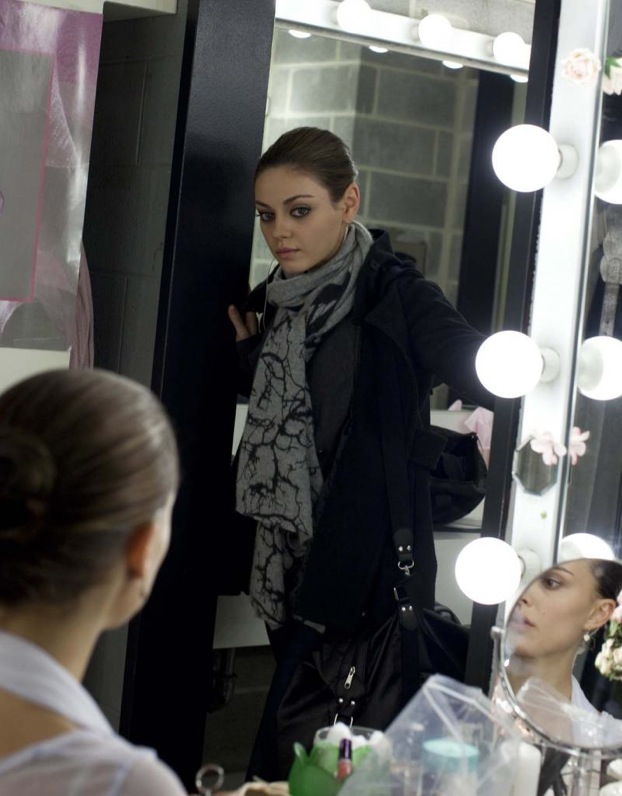
The narrator, or more accurately the POV, becomes unreliable.  Nina’s point of view becomes so unreliable I still don’t know what happened exactly. Some of the events could have just been figments of her imagination, not unlike some of the events in Repulsion, but in the end I wish I knew what to believe regarding some of the characters, especially Lily. In fact, Nina’s delusions even distort how she sees her own reflection as Aronofsky delves heavily into a mirror motif.

Everything builds to a true metamorphosis of character which is handled with tremendous skill by Portman.  This is the performance that will define her career. Vincent Cassell is perfect as the creative director, and I would say it’s his best since La Haine if it weren’t for his brilliant work in Mesrine just last year. In the end, the performances were great all around. The atmosphere for the screening was perfect. It was a smart, thrilling picture.  So why didn’t I love it like it feels I should?

First, I was too aware of the camera.  Like in The Wrestler we have long hand-held following shots, but this is a different story. The Wrestler felt like we needed that rough filming, that observational feel, but Black Swan is a new story and I felt called for a new style.  I know Aronofsky abhors the steadi-cam but using a more fluid motion for the long tracking shots would have complimented the perfection and grace of the ballerina, at least until her life became chaotic.

Second, it felt like Aronofsky was too intellectual with this film. That’s why there is so much to write about. You could write essays on his use of mirrors, on the ritual, on the sexual repression, self-mutilation or the transformation you undergo as you strive for perfection, but that’s not why most people go see movies. Yes, he’s a very smart guy. Yes, he knows how to direct a good film.  But I can’t help feeling that he is lost in his own ritual as he directs, creating films that are almost entirely cerebral and not visceral. His best film is still Requiem and it’s because there he had true passion. He was experimenting and attacked his first big release with a rookie’s recklessness.  It’s like Thomas tells Nina, you have to get out of your head. You need to let the emotion take over and only then can you reach perfection because then you will find the ability to surprise yourself and the audience.  I was hoping for something surprising with Black Swan. It’s still a very good film; it’s still worth seeing in the theater because that’s the only way to experience what should be an Oscar winning score, but if the reins would have been loosened this film could have been so much more.

Below are several of the movie posters, which I thought were fantastic.

Categories: Patton Notes, See It Tags:

A Note on The Holy Mountain

November 20th, 2010 No comments

today’s posting written by a friend on the fringe, Eric Rowe

Alejandro Jodorowsky’s The Holy Mountain is a bizarre, surreal satirical exploration of a man’s quest for his inner truth.  On that note, this is not a film for everyone.  That needs repeating; this is not a film for everyone.  This is the type of film that would shock most casual viewers by its grotesque, yet beautiful visuals and overall unconventional story telling.

The Holy Mountain is one of my favorite films because of the challenge it poses to its viewers to think critically, not only about the film but also about their own personal spirituality, society, and religion.  The film follows a Christ-like figure that wanders through a bizarre, perverse land where he encounters a mystical enlightened guide, whom sends him on a spiritual pilgrimage.  The film is stuffed full of beautiful, however perverse, imagery as the viewer follows this Christ-like figure through his pilgrimage.  The most common response to the film is that it attacks organized religion, though this is most likely an effort of average moviegoers to dismiss the film and avoid deeper reflection. Upon closer examination one can see that Jodorowsky was trying to illuminate precisely how primitive our understanding of the world can be. As the theorist Abraham Maslow suggested in A Theory of Human Motivation, self-actualization is the highest stage of human physiological development. This film illustrates the journey to this end.

At first glance, the film appears to be a simple hero’s journey, a man seeking truth in a maniac world, but it also must be interpreted as a reflection on both Jodorowsky’s and the audiences’ lives.  The Christ-like figure must face the numerous temptations of this world. Along this journey Jodorowsky stresses the importance of making one’s own decisions and the consequences that ensue.  In an early scene the protagonist walks through Mexico City to observe all of the city’s grotesque distractions that astonish the eye and confuse the mind.  It is a bizarre festival of whores, soldiers, and liars. After taking it all in, the figure then meets priests who befriend him and proceed to mass-produce a mold of him under the promise of enlightenment.  They have created a product that is promised to bring clarity, belying their true intention to market it to society, in effect emulating the everyday promises of new technologies. It’s a concept that has been used throughout history. The figure, disgusted by this greed, flees on a journey to find his personal truth.  In this way Jodorowsky suggests that man sees the world as chaos. He further suggests that each person must arrive at his or her own conclusions, finding their own personal truth without being alienated by a society whose intentions may be deceptive.

The final act of the film is the most linear in that this is when the actual journey towards enlightenment takes place. Our protagonist has faced many challenges on the path to enlightenment: distractions, debauchery, and confronting personal fears.  After all the trials and tribulations the figure, and those who have joined him along the way, complete their journey to the top of a mountain.  Again this is reminiscent of Maslow’s Hierarchy of Needs, where the ultimate twist is revealed and the alchemist breaks the fourth wall as if to tell the audience, “What did you expect?  This is just a movie!”

In the end, Jodorowsky does not provide any obvious answers, implying that viewers must find their own meanings and identify their own self-actualization. Jodorowsky makes his final statement about spirituality and beliefs perfectly with this ending, asking each of us to find our own truth because life is a series of experiences that no one can fully understand or can possibly interpret in the same way.  The film suggests that society at times can frighten, tempt, and distract, and if one cannot accept these, then they will not experience the pinnacle of true living. Thus, we all must experience life for ourselves, finding truth and meaning in its events as they pertain to our selves. For the film The Holy Mountain, as in life, one must find his own meaning and develop his own interpretations. This was mine.

Categories: Eric Rowe, Guest Blogger Tags:

Notes on The Color of Paradise

November 7th, 2010 No comments

A lazy Saturday – I finished watching  True Grit, went to Costco with the wife and daughter then returned to watch The Color of Paradise, a beautiful Iranian film from filmmaker Majid Majidi.  The DVD came from Netflix months ago, renting on the recommendation of my friend Adnan. But with a new baby I rarely have time to sit down and give foreign films their due attention. Luckily Boston was kind enough to take an afternoon nap long enough for me to enjoy this poetic and deeply affecting film.

The film quickly introduces us to Mohammad, our amiable child protagonist.  We first see him at school where he excels at his learning, he has an open and friendly relationship with his teacher and gets along with his fellow students.  He appears to be a healthy, normal student except we find him at a special school for the blind.  Here he fits in with the other blind students and is rather comfortable. But this is the final day of school and everyone waits for their families to pick them up to go home for the 3 month summer break.  The other students are picked up, they are met by happy, hurried parents. Mohammad waits. The final classmate fades from the scene, and Mohammad still waits.

The film focuses on the people and creatures in the world in need of compassion and assistance.  While waiting for his neglectful father, Mohammad can hear the desperate chirp from a bird in distress.  He feels his way through the woods, searching for the struggling animal. He even scares off a hungry calico in order to rescue the bird.  This blind child’s benevolence is not easily discouraged.  He struggles to climb a tree, feeling each individual branch in search of the nest. It’s a show of pure determination and compassion. It’s the sort of compassion his father is completely incapable of showing.

From the moment we meet Mohammad’s father he is looking for a way to relinquish his responsibilities as a father to everyone else. To quote my wife, “his dad’s a dick.”  Well said wife. Hossein Mahjoub plays Father’s emotional dilemma with a solemn intensity that makes you despise the character. He isn’t a man for whom you feel sympathy. You might pity him, as his mother in the film does.  And, if you are the rare audience member that can feel sympathetic toward his situation, that feeling will quickly escape you during the scene between Mohammad and the blind carpenter.

As the Blind Carpenter is teaching Mohammad how to identify certain types of wood by their density he feels Mohammad’s tears.  The young actor launches into a brief monologue about having no love in his life. He expresses he understands that people are always trying to run from him, nobody wants to care for him and its all because he is blind.  Maybe if he could see, he tells his mentor, he could earn the love of his family, but being blind is not his fault. He continues to say that he walks through the world with his hands stretched out hoping he can touch God one day, and asking him why life is as it is.  It’s a beautiful scene and the monologue is captured in one medium close-up meaning all the emotion came from this young actor (Mohsen Ramezani), not from the camera, not from the editing and not from any sort of swelling orchestral score.

As we see Mohammad flopping around in life, looking for a loving hand to reach out to him, we are also shown another animal in distress. Mohammad’s grandma set out to bring Mohammad back home when she comes across a fish flopping in shallow water. In a frail state she strains herself to bend over, picking up the fish and gently placing him in deeper water.  She’s the only character that accepts her role in Mohammad’s life and the only other character that helps an animal in distress. She’s connected to Mohammad through a shared compassion for the world around them.

As Father and Mohammad walk through the woods we are shown a quick shot of a turtle struggling between two rocks.  It’s a silent struggle, so Mohammad cannot hear the turtle although you can be assured that he would have helped. Father didn’t see the turtle and that is just as important as if he saw it and passed it by.  He is too self-involved, consumed with self-pity to be aware of others that may need a helping hand.  And this leads into the final climatic scene.  I will spare you the details as to not spoil it, but Father is faced with the decision whether he wants to save Mohammad’s life or if he’d be better off with Mohammad dying. It’s a powerful climax and ends with one single frame that inspires hope.  This final frame is the sort of optimism we were hoping we’d see through out this depressing story.

This ending is something I find common in films from this region, and I’m in love with the use of one final image that changes our entire mood.  I can tell this film has inspired my friend Adnan as you get the some final sense of hope in his short films, Maggie’s Heart and Heal.  It also reminds me of the final moment in A Moment of Innocence, by Iranian filmmaker Mohsen Makhmalbaf. If you haven’t seen A Moment of Innocence, put it in your Netflix queue now! In fact, add The Color of Paradise and add Turtles Can Fly, a film by a Kurdish-Iranian filmmaker Bahman Ghobadi.

These are filmmakers from what has been called the Iranian New Wave. They’re from a  country that the US Government at one time put in “The Axis of Evil.”  Yes, Iran did at one time ban A Moment of Innocence, but if their films are any indication of the spirit of the people then ‘evil’ is a horrible, all-encapsulating term to use.  Their films exemplify the beauty found in a child-like innocence and blind optimism.

(sorry this note is about 10 years late)

Categories: Patton Notes, See It Tags:

Notes on The Social Network

October 31st, 2010 No comments

“I have never heard a story as horrible as this…This time, I may finally lose my faith in the human soul.  It’s worse than bandits, the plague, famine, fire or war.” ~ the priest in Rashomon

It was date night, our first time out since Boston was born four months ago and we left her in the capable hands of Zalman, a Facebook friend of ours.  I’m 29, leaving my one bedroom LA apartment with my wife days before she turns 30 as we say good-bye to our four-month-old daughter so we can see a movie about a 26 year-old billionaire.

I do my best to ignore the barrage of AMC’s pre-movie distractions, but they seep in and The Social Network is served an unfair blow because these ads and behind-the-scenes look at Grown-Ups put a sour taste in my mouth.  Luckily I bought Hot Tamales.

Without us knowing we had appropriately bought tickets to a love story.  Apparently, according the movie, at the very center of Zuckerberg’s ambition to build Facebook was for the love for a girl.  So right out of the gate I started to feel this film holds all the veracity of a Michael Moore picture. And maybe that is the point.

Truffaut believes that what you say in a film is not nearly as important as how you say it. Sorkin and Fincher decided to tell The Social Network in a Rashomon-style where we are piecing together the events as they are being retold during two coinciding depositions.  Rashomon was the film that famously got us to start questioning the truth of what we were being shown. Kurosawa gave us unreliable narrators to tell a story and here, with the story of Facebook, the style is eerily appropriate. We are watching a story interpreted by a director from a script adapted from book written by an author who gathered information from potentially unreliable sources several degrees removed from the actual events. We’ve all played Telephone and the lesson of that game tells us the more people in between the event and report the greater the inaccuracies.

So we can disregard this film as an honest depiction of historical events and evaluate it for what it really is; a story about unbridled ambition, revenge and greed. It may not be accurate, but damn it! It makes for great movies.

The opening scene of the movie displays Sorkin’s version of Zuckerberg; this intelligent, arrogant kid who loves to belittle his girlfriend while offering her a chance to met people “she’d never get to met.”  He might find himself gracious or charitable without realizing that he is condescending.  He moves so quickly through conversation, almost hoping to surpass his counterpart, only to ridicule her when she doesn’t keep up with the conversation. We even get that first taste of Zuckerberg’s lack of perception when it comes to social interaction. She breaks up with him, but he needs to ask for a clarification, “is this real?” Receiving the affirmative he apologizes, insincerely and devoid of emotion, and is then left at a crowded bar, friendless.  It is a foreshadowing of Zuckerberg’s ability to distance himself from the emotional bond that can form between two people.

Suddenly, we’re at Harvard, but movie Harvard.  It’s the magical land where your closest friends come from wealthy legacy families, are 6 foot 5, love to row boats and come in duplicate.  It is the elite environment of the world’s future leaders where every student is a verbal acrobat capable of using their caustic wit and mental prowess to best even the most skilled and prepared litigators. It’s necessary to paint the student body this way because inarticulate, snarky, over-privileged 20 year-olds wouldn’t be nearly as entertaining as they become litigious and vindictive.

A brilliant sequence cut by Kirk Baxter and Angus Wall juxtaposes frat boys and Final Clubs drinking, snorting drugs and coaxing sluts to strip for them while Zuckerberg is getting drunk in his dorm creating “Facemash,” a website in response to his recent break-up that quickly crashes the Harvard server.  The sequence immediately transports me back to undergrad where I was drinking with friends and laughing as we rated people on hotornot.com.  It was juvenile, as was Facemash.  But Facemash was prologue to a collaboration, an Internet sensation and multi-million dollar lawsuits while for the rest of us it was simply a prologue to joining their future site.

As The Facebook starts to evolve Zuckerberg throws ownership percentages around as freely as beers and bottle caps.  He grabs 65%, giving 30% to Eduardo Saverin (Andrew Garfield) and 5% to Dustin Moskovitz (Joseph Mazzello).  But as the popularity of the site starts to stretch across the continent it attracts the attention of Sean Parker, played by pop-star Justin Timberlake. The decision to cast Timberlake must have been as much about him being a pop-star with that ostentatious aura as it was about his similar appearance to Parker.  It’s something the actor and the subject share.  It’s magnetism, it’s a command of the room when he enters.

The “rock-star” Internet rebel from Napster brings the flashy west-coast swagger to the team, creating a beautiful dichotomy of the coasts.  The east-coast is the pragmatism and the dedication to a code of ethics as one of the Winklevosses (Winklevi?) refuses to sue Zuckerberg because “we don’t sue other students.”  The west-coast is the celebrity.  It is the fast-paced mirage of a better life, with woman and drugs and venture capitalists that are ready to throw millions of dollars at college dropouts in their early twenties. It is the coast where ethics and rules get in the way of business and loyalty is as valuable as diluted shares of the soon-to-be ubiquitous dot com.

Zuckerberg is of course seduced by this tempter from the West and moves to Palo Alto. Facebook moves with such a momentum he can feel that Eduardo will soon “be left behind,” but even acknowledging this momentum he does little to control it. Sorkin wrote Zuckerberg as this conniving, egomaniacal kid easily seduced by the promise of gaining influence and information.  He uses the seed planted by the Winklevosses to expand without them, he betrays his founding partner and yet Fincher directs this script in a way that he shows sympathy toward Zuckerberg. There is a battle of perception. Fincher’s direction leads me to believe that he might admire Zuckerberg.

Fincher seems to enjoy exploring those heroes on the fringes of society, the one not fitting in, but then bring people together.  In Fight Club the outcast searches for a connection in support groups but finds it engaging in fights with others.  In Fight Club they throw fists, in The Social Network they hurl verbal assaults during litigation.  Fincher seems to favor those eccentric characters that rage against the establishment.  It was again very appropriate that the screenwriter and the director seem to have opposing feelings toward the hero of this film.  No two audience members walk away from The Social Network sharing the same feelings toward Zuckerberg and I think that is how it should be.  In the end our hero is isolated, alone with his creation, refreshing his screen in hopes that the past is somehow reconciled.  And you almost feel sorry for him.  But then again, it’s difficult to feel sorry for the world’s youngest billionaire.

We left the theater and walked to dinner at a place call Rock Sugar in Century City where a man wearing an ascot, that’s right a freakin’ ascot, showed us to our table.  It was an opulent restaurant with flashy patrons and $14 martinis.  A woman with artificial curves and dressed like a slutty cheetah sat behind me and behind Lindsey sat what I can only guess was a Viet-Cong soldier with two Hanoi hookers. Halloween always brings out the best costumes: a slutty cheetah, a slutty ninja turtle or even a slutty pumpkin. And with the look-at-me west-coast of Sean Parker sharing a meal with us Lindsey and I felt between two coasts. We ordered beer, some cheap-ish chicken and went back to our one-bedroom apartment to find two friends (real friends, not just virtual) watching over our sleeping daughter.

(i post this fully aware you may have found by way of a link i posted on facebook.  how magnificent)

Categories: Patton Notes Tags: